Showing posts with label Business communication degree solutions. Show all posts

Thursday, July 5, 2012

Explain the liabilities of a company secretary

Explain the liabilities of a company secretary

Hello dear friends here you will get Explain the liabilities of a company secretary. Liabilities of a company secretary can be divided into two categories: Business communication degree solutions
(A) Statutory Liabilities
              And
 (B) Contractual Liabilities

(A) Statutory Liabilities: Statutory liabilities derived from different relevant Acts including companies Act, Stamp Act, Income tax Act etc. statutory liabilities are as follows: Business communication degree solutions

1. Maintain the formalities during pre-incorporation stage
2. Arranging the statutory meeting within the stipulated time limit
3. Preparation of statutory report
4. Arranging the meeting of Board of Directors
5. Arranging the Annual General Meeting
6. Submitting Annual Returns to the Registrar of the companies
 7. Maintaining ‘Minute-book’
8. Taking initiative of the registration of the resolutions passed in different meetings
9. Ensuring proper stamping of the documents
10. Arranging the appointment of auditor in time
11. Maintains the register of the shareholders and debenture holders of the company
12. Taking initiative to pay the income tax in time
13. Not to take any loan without the approval of the Board of Directors
14. Not to secure any secret profit form the company etc.

(B) Contractual Liabilities: According to the agreement signed between the company and the secretary different types of liabilities imposed on the secretary. These liabilities are as follows: Business communication degree solutions

1. Accountable to the Board of Directors for duties
2. Maintaining the secrecy of the affairs of the company
3. Not to do anything beyond his/her capacity
4. Not to show any kind of negligence in performing the responsibility
5. Not to commit any fraudulent activity
6. Protect the interest of the company.
7. Obeying the terms and conditions of the service
8. Maintain the rules and procedures of the Memorandum of Association and Articles of Association, Act.

Explain the liabilities of a company secretary

Hello dear friends thanks for visiting this site and post. Business communication degree solutions. Friend if you like this Explain the liabilities of a company secretary article then do comments and share. Friends you will get another supper related post "Right and power of a company secretary".

Tuesday, July 3, 2012

Right and power of a company secretary

Right and power of a company secretary

Hello dear frinds here you will get The right and power of a Company Secretary, Company Secretary Right, Company Secretary Power. Depending on the companies Act and condition of the agreement, rights of a company secretary can be classified into following types:
Business communication degree solutions
(A) Consequential rights
(B) Contractual rights
(C) Rights recognized by the companies Act.

(A) Consequential rights: Consequential rights of a company secretary are as follows: Business communication degree solutions
1. Control office functions: As the principal officer of the company the secretary has the right to control the office functions.

2. Negotiation: A company secretary also has the right to negotiate with third party on company affairs.

3. Sign contracts: As the agent of the company secretary can sign agreements or contracts.

4. Sign documents: As an important administrative officer the secretary of the company has the right to sign in the documents of the company.

5. Remuneration: A company secretary deserves logical remuneration from the company.

(B) Contractual rights: Contractual rights derive from the agreement between the company and the secretary. On the basis of the agreement the secretary can enjoy the following fights: Business communication degree solutions

1. Authority: On the basis of the agreement company secretary can exercise specific authority.

2. Implementation of agreement: Company secretary can implement the agreement by which he is appointed.

3. Termination of agreement: As per provision of the agreement the secretary has the right to terminate the agreement.

(C) Rights recognized by the companies act: Rights recognized by the companies act are as follows: Business communication degree solutions

1. Commencement of business: As per companies act the secretary has the right to sign the declaration of the commencement of business.

2. Sign annual return: Within 60 days of the Annual General Meeting (AGM) the company secretary has the right to sign Annual return of the company.

3. Making statements: On behalf of the company the secretary can make statements.

4. Preferential creditor: If the company goes to liquidation then the secretary can claim his/her dues prior to others.

5. Attend in the meeting: The secretary also enjoy the right to attend in the meetings of the company.

6. Declaration of solvency: In case of voluntary winding-up the company secretary has the right to sign the declaration of solvency.

Right and power of a company secretary

Hello dear friends thanks for visiting this site and post. Business communication degree solutions. Friend if you like this Right and power of a company secretary article then do comments and share. Friends you will get another supper related post "The functions or duties of a company secretary".

Thursday, June 28, 2012

The functions or duties of a company secretary

The functions or duties of a company secretary

Hello dear friends here you will get the functions or duties of a company secretary. Friends you also get anther article about How a company secretary can be removed from this post? As an important person of the company a secretary has to perform various functions. Even before the incorporation of the company a secretary is appointed to conduct the promotional activates regarding the formation of the company.

The function or duties of a company secretary can be discussed in the following manner:
(A) Pre-incorporation functions
(B) Post-incorporation function
(C) Routine functions

(A) Pre-Incorporation function: Functions performed by the first secretary of a company before the incorporation of the company is known as the pre-incorporation functions. Generally following activates performed in pre-incorporation stage:
1. Functions regarding the registration of the company.
2. Drafting articles of association.
3. Drafting articles of association.
4. Collecting certificate of incorporation form the registrar of the companies.
5. Conducting meeting among the promoters.

(B) Post-incorporation Functions: Following functions are accomplished by a company secretary after the incorporation of the company:
1. Arranging the meeting of the board of directors.
2. Collection of the certificate of commencement.
3. Arranging the statutory meeting of the company.
4. Preparation of statutory report etc.

(C) Routine functions: Routine functions of a company secretary can be classified into following categories:
1. Functions relating to shareholders:
i. Circulation of the prospectus.
ii. Receiving application for shares.
iii. Checking applications
iv. Making calls and taking initiative to collect calls-in arrears.
v. Distribution of share certificates.
vi. Informing the shareholders regarding meeting by notice.
vii. Declaration of dividend.

2. Functions regarding directors:
i. Arranging the meetings of board of directors (BOD)
ii. Preparation of minutes
iii. Implement the decisions of the Board meeting.
iv. Informing relevant matters to the BOD.

3. Functions regarding the meetings of the company:
i. Arranging different types of meetings.
ii. Preparation of agenda of meeting.
iii. Providing notice to the members
iv. Assist to run the meeting.
v. preparation of the minute book.
vi. Informing the members regarding the resolution passed in the meeting.

4. Advisory functions:
i. Providing relevant information to the top management to assist routine administrative functions.
ii. Assist policy formulation.
iii. Provide advice on the raising of funds
iv. Provide direction for negotiating third parties.
v. Assist in drafting agreement.

5. Liaison functions: Besides the above specific functions a company secretary maintain link among the concerned parties of the company. A company secretary in treated as the principal liaison officer of the company.

The functions or duties of a company secretary

Tuesday, June 26, 2012

The procedure regarding the appointment of a company secretary

The procedure regarding the appointment of a company secretary

Hello dear friends here you will get The procedure regarding the appointment of a company secretary. For public limited companies appointment of secretary is made compulsory by the companies act. A company secretary can be appointed by the following ways: Business communication degree solutions.

1. By Promoters: To accomplish the promotional work of the company the promoters appoint the first secretary of the company. The name of the first secretary is mentioned in the articles of association of the company. The board of directors ratified the appointment of the first secretary at the first meeting of board of directors (after the incorporation) with retrospective effect from the date of appointment.

2. By the first board of directors: The company secretary can be appointed by the directors at the first meeting of the board of directors. Whether the first secretary will be removed or reappointed, completely depends on the opinion of the members of board of directors.

3. From the directors: The board of directors (BOD) can appoint a director as the secretary of the company.

 4. Professional secretary: The board of directors can appoint a professional secretary as the ‘secretary’ of the company. An agreement mentioning terms and condition of the service is signed between the company and the person appointed as the secretary of the company.

These are the different methods followed for appointing the company secretary.

The procedure regarding the appointment of a company secretary

Hello dear friends thanks for visiting this site and post. Business communication degree solutions. Friend if you like this The procedure regarding the appointment of a company secretary article then do comments and share. Friends you will get another supper related post "Qualifications of a company secretary".

Thursday, June 21, 2012

Qualifications of a company secretary

Qualifications of a company secretary

Hello dear friends here you will get Qualifications of a company secretary or Requirements of a company secretary. A company secretary must have qualifications prescribed in the companies Act and also should achieve required attributes to perform the functions of a secretary.

Qualifications of a company secretary can be divided into two categories:
(A) General qualifications
(B) Professional qualifications

(A) General qualifications: To perform the important functions of a secretary one should have the following general qualifications:

1. Attentive: A company secretary must be attentive and good listener.

2. Adaptability: Another important attribute of a company secretary is adaptation power. To ensure the interest of the company the company secretary need to adopt with different situation.

3. Boldness: To perform his/her duty and to uphold the interest of the company, a company secretary needs to have boldness. Boldness is specially required in negotiating with third parties.

4. Careful: In performing the duties a company secretary needs to be careful.

5. Cooperative: A company secretary is treated as the principal liaison officer, thus to ensure desired coordination among the concerned parties he/she must be cooperative.

6. Polite: for better acceptance and successful public relation a company secretary should be polite in nature.

7. Punctuality: A company secretary also should be punctual.

8. Responsible: As a company secretary one has to perform various important functions. The interest of the company can be hampered if any irresponsible step taken by the company secretary. Thus responsibility is an indispensable step taken by the company secretary. Thus responsibility is an indispensable attribute of a company secretary.

9. Reliable: another major quality of a company secretary is reliability.

10. Honesty: Last of all, but not the least, a company secretary must be honest. Other qualifications can be meaningless without honesty.

(B) Professional Qualifications: Besides the discussed general qualifications a company secretary must possess some professional qualifications to run the office of secretary. Professional qualifications can be listed as follows:

1. Required educational qualification: A company secretary must have educational qualification as required by the company. Besides qualification in business education a company secretary also need to have qualification on secretarial science.

2. Efficiency in shorthand: To take dictation and to maintain the minute book a company secretary must be efficient in shorthand.

3. Efficiency in typing: A company secretary need to type different official documents on a regular basis, thus he/she also should be efficient in typing.

4. Efficiency in computer operation: In modern days a company secretary has to handle computer to receive and to send messages thus efficiency in computer operations has become an indispensable quality of a company secretary.

5. Proficiency in language: To communicate with the external parties and to maintain routine communication a company secretary must have proficiency in written and spoken form of language. Besides the own language a company secretary need to have proficiency in English language.

6. Knowledge regarding the company affairs: As a company secretary one should have detail knowledge on the company affairs.

7. Knowledge regarding company law: Knowledge regarding company law is treated as a ‘sine-qua-non’ for a company secretary. To conduct the routine functions and to maintain the proceedings of a meeting a company secretary must have in-depth knowledge of company law.

8. Knowledge of other laws: A company secretary also should have sound knowledge regarding contact law, Insurance Act. And other laws relating to the affairs of the company.

9. Efficiency in arranging meeting: As the secretary of a company one has to arrange different types of meeting on a regular basis throughout his/her tenure of service. Thus detail knowledge regarding the holding of meetings must be possessed by the company secretary.

10. Efficiency in office management: A company secretary also should have knowledge of office management.

11. Efficiency in Accounting and finance: To handle the company affairs a company secretary must have efficiency in Accounting and finance.

To be a successful company secretary one should have a clear concept regarding the very ‘nature of business’ of the company.

Qualifications of a company secretary

Hello dear friends thanks for visiting this site and post. Negosyo. Friend if you like this Qualifications of a company secretary this article then do comments and share. Friends you will get another supper related post "Evaluate the legal position of a company secretary".

Evaluate the legal position of a company secretary

Evaluate the legal position of a company secretary

Hello dear friends here you will get Evaluate the legal position of a company secretary. The post of the company secretary is created and defined by the companies Act. Thus company secretary has legal position in the company.

In the companies Act and in verdicts of different cases legal position of a company secretary have explained in the following manner:

1. Officer of the company: According to section of the companies act. 1994 secretary is an ‘officer’ of the company.

2. Servant of the company: in the case ‘Barnet Hoars & Co. vs. South London Tramways Co.’ the honorable judge treated secretary as a servant of the company. The secretary as a servant will perform under the supervision of the Board of Directors.

3. Agent of the company: If the Board of Directors delegates authority then the secretary can act as an agent of the company. As an agent the company secretary can negotiate with third parties regarding signing of agreement.

4. Coordinator of the company: A company secretary also acts as a coordinator. The secretary maintains link between concerned parties.

5. Adviser of the company: Having detail knowledge in commerce and company affairs the secretary play vital role in providing expert advice to the top management.

From the above discussion it is clear that, the legal position of a company secretary can be viewed form different dimension.

Evaluate the legal position of a company secretary

Hello dear friends thanks for visiting this site and post. Negosyo. Friend if you like this Evaluate the legal position of a company secretary this article then do comments and share. Friends you will get another supper related post "What is company secretary?".

Thursday, June 14, 2012

What is company secretary?

What is company secretary?

Hello dear friends here you will get What is company secretary? and Define company secretary. Unlike a private secretary the status of a company secretary is legally defined. The person who holds the position of the secretary of a company can be termed as ‘company secretary’.
Indian companies act, 1956 (amended, 1974), defines a secretary as “Any individual possessing the prescribed qualifications appointed to perform the duties which may be performed by a secretary under this act and any other ministerial or administrative duties.”

In the words of Prof. sen & Mitra, “The secretary is an officer of the company having specified duties.

Prof. R. Pal and J. S. Korlahalli stated that, “He (Secretary) acts as a vital link between the company, Board of directors, shareholders and the Government and other regulating agencies.”

From the above definitions following features of a company secretary can be identified:
i. has a legal position.
ii. Duties specified by the law.
iii. Should have appropriate qualification.
iv. Link among concerned parties.

Thus it can be said that the person who appointed as a secretary in compliance with the companies Act., performing prescribed duties and maintaining link among the stakeholders can be labeled as ‘company secretary’.

What is company secretary?

Hello dear friends thanks for visiting this site and post. Negosyo. Friend if you like this What is company secretary? and Define company secretary this article then do comments and share. Friends you will get another supper related post "The importance of a secretary".

The importance of a secretary

The importance of a secretary

Hello dear friends here you will get the importance of a secretary. As work load of executives increases, the importance of secretarial function also increases considerably, with the dramatic improvement of communication system the world become a global village.

No individual or firm can expect to gain competitive advantage without concentrating on the external communication. As a result in a modern organization secretary is not treated as a receptionist or a liaison officer, rather he/she is an indispensable part of the management.

In the words of R. Pal and J. S. Korlahalli, “The position (of secretary) is considerably changed now; the secretary has gained the confidence of the management and has come to be recognized as the principal officer of the company.”

The importance of a secretary can be discussed in the following manner:
1. Information collection: A private secretary or a company secretary who ever it is, the position of the secretary become extremely important for both individual and firm. One of the major reasons is secretary is that person who collect and preserve all relevant information and provide it in time to the concerned parties.

2. Making policies: Secretary of a modern firm is not busy with only steno typing or taking dictation. He is fully associated with the formulation of long-range and short-term corporate policies and programmers.

 3. Providing advice: As a qualified person having knowledge about various area of commerce, secretary also play important role by providing advice to the top management.

4. Organize meeting: In arranging meeting the role of secretary has immense important to the firm. In the following way secretary play significant role in arranging meeting:

i. Preparing Agenda
ii. Providing Notice
iii. Preserving minute book
iv. Preparation of reports etc.

5. Raising funds: In a modern company secretary is also involved in the process of raising funds from external sources. Secretary assists to prepare ‘prospectus’ which is disclosed for public issues of shares.

6. Transfer of shares: The process of share transfer is also assisted by the secretary.

7. Assist in making appointment schedule: Appointment schedule of the executive or of the employer also prepared by a secretary.

8. Negotiating business purchases: In case of business purchases, mergers, and etc secretary assist considerably by taking part in the negotiation with concerned practices.

9. Correspondence with stakeholders: Secretary bridges the gap between the stakeholders of the firm, viz. shareholders, directors, creditors, financial institutions, government agencies etc.

10. Efficiency: by establishing link among the concerned parties secretary ensure coordination, which ultimately increase the overall efficiency of the firm.

Besides these secretary also files different types of documents to the registrar of companies in compliance with the companies act.

The importance of a secretary

Hello dear friends thanks for visiting this site and post. Negosyo. Friend if you like this The importance of a secretary this article then do comments and share. Friends you will get another supper related post "Advantages and disadvantages of graphical representation in a report".

Thursday, June 7, 2012

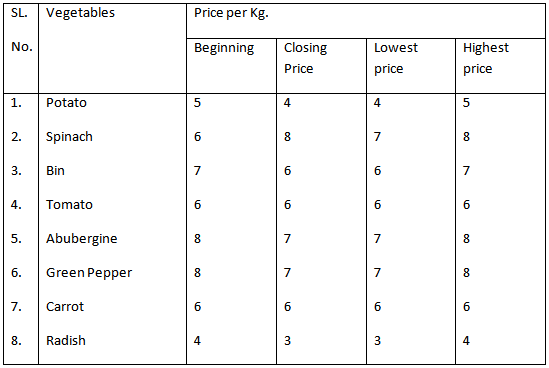
Draft a weekly market report on the Coimbatore Market ‘Vegetable Market’

Draft a weekly market report on the Coimbatore Market ‘Vegetable Market'

Hello dear friends here you will get Draft a weekly market report on the Coimbatore Market ‘Vegetable Market’ of Introduction:
Title of the Report: Weekly market report on the ‘Vegetable Market’ of Coimbatore Market.
Market’s Name: Coimbatore
Market Nature of Trading: Wholesale
Location: Near Tamil Nadu, USA
Product: Vegetables
Duration of the survey: Feb. 07, 2006 to Feb. 13, 2006
Date of submission: Feb. 14, 2006

Introductory Statement: In the survey period comparatively high price observed. A frequent fluctuation of prices of different vegetables was another major feature of the market.

Body of the report: 
Supply of vegetables: During the survey period comparatively low level of supply has been recorded. In comparison to the previous week. Overall supply of vegetables was low.

 Reason for low supply: it is revealed that due to ‘heavy fog’ traffic jam created in the ferry-ghat. As a result loading-unloading seriously disturbed. It causes late-arrival of vegetables in the market, which ultimately leads to higher prices.

Lack of control: Despite market monitoring some mal-practices among the traders also being observed Causes for frequent fluctuations of prices are not logical in some cases.

Expectations: As winter progresses, supply of vegetable likely to increase and prices will tend to reduce in the next week.

Example of Market rates of vegetables:
Trend of price: At the beginning of the week prices of most of the vegetables were higher than those of end of the week.

Conclusion: Significant price fluctuation was the order of the week. The market price level is expected to be more stable in the next week as supply is likely to increase. Monitoring should be continued and loading-unloading facilities need to be improved.

Draft a weekly market report on the Coimbatore Market ‘Vegetable Market'

Hello dear friends thanks for visiting this site and post. Negosyo. Friend if you like this Draft a weekly market report on the Coimbatore Market ‘Vegetable Market’ this article then do comments and share. Friends you will get another supper related post "The essential features of a market report".

The essential features of a market report

The essential features of a market report

Hello dear friends here you will get what factors should be considered in drafting a market report?Or, the essential features of a market report.

To be effective, a market report should considerer the following factors:
1. Determination of objective: Like any other report market report also should be prepared by fixing predetermined objectives. Specific objectives or purposes infect act as a guideline for the preparation of the report.

2. Selection of market: On which market research will be conducted that also should be fixed in advance.

3. Avoid personal biases: In preparing the market report the reporter must be aware of personal biases. Personal likings or disliking should not affect the findings of the report.

4. Specific format: As market report is very important for the preparation of marketing strategy, it must be prepare like a formal report.

5. Appropriate method of data collection: Depending on the nature of the market and location of the consumer’s appropriate method of data collection should be selected.

6. Sensitiveness of the market: While preparing the market report, the reporter needs to consider the degree of sensitiveness of the market.

7. Selection of time: The trend of market may fluctuate over time. Thus the selection of time of research may influence the findings of the report.

8. Recommendations: Recommendations is an essential part of any report, therefore like other formal reports a market report must include specific recommendations for the betterment of the marketing strategy.

The essential features of a market report

Hello dear friends thanks for visiting this site and post. Negosyo. Friend if you like this The essential features of a market report,What factors should be considered in drafting a market report? this article then do comments and share. Friends you will get another supper related post "What is market report?, The importance or advantages of market report".

Friday, June 1, 2012

Difference between formal and informal reports

Difference between formal and informal reports

Hello dear friends here you will get difference between formal and informal reportsor Distinguish between long and short report.

Formal reports are analytical in nature and follow specific format. On the other hand informal reports are short and used basically for routine functions of an organization.

Distinction or Differences between formal and informal reports are as follows:

Difference between formal and informal reports

Hello dear friends thanks for visiting this site and post. Negosyo. Friend if you like this Difference between formal and informal reports or Distinguish between long and short reportthis article then do comments and share. Friends you will get another supper related post "What is informational and analytical report?".

What is informational and analytical report?

What is informational and analytical report?

Hello dear friends here you will get what is informational and analytical report? Distinguish between informational and analytical report.

Informational report: informational reports include only presentation of information detailed discussion and analysis are not provided. These reports are small in size.

Analytical report: this type of report provides detailed discussion on the basis of analyzed data. Unlike informational report this type of report includes recommendations.

Differences between informational and analytical reports are as follows:

What is informational and analytical report?

Hello dear friends thanks for visiting this site and post. Negosyo. Friend if you like this what is informational and analytical report? Distinguish between informational and analytical report this article then do comments and share. Friends you will get another supper related post "What do you mean by informal report?".

Thursday, May 31, 2012

What do you mean by informal report?

What do you mean by informal report?

Hello dear friend here you will get what do you mean by informal report? What is informal report?, Define informal report. Mention the features of informal report and you also get The important or uses of informal report.

Informal reports basically used for routine functions of an organization. Informal reports are widely used in corporate sector for conveying routine internal messages. There are not research based and take short time to prepare.

In the words of Ricks and Gow, “informal reports are commonly used vehicles to help managers in planning, organizing, staffing and controlling.”

Staff report, progress report, short audit reports etc. are examples of informal report. Features of informal report;
1. Used for conveying routine messages
2. Helps in day to day managerial functions.
3. Begin directly with conclusions and recommendations.
4. Length is short.
5. Introductory and prefatory parts are not required.
6. Usually follow preprinted form, letter formal or memo format.
7. Basic objectives are to inform and to recommend action.

The important or uses of informal report
Informal reports are used frequently to support routine business functions. It is very important for smooth operation of an organization. Uses of informal reports are as follow:
1. To inform weekly production
2. to record absenteeism.
3. Weekly or quarterly sales progress.
4. To inform consumers complaints.
5. To transmit data relating to labor turnover (By the supervisor to Human Resource Manager)
6. Performance report
7. To inform the effectiveness of promotional activities.

What do you mean by informal report?

Hello dear friends thanks for visiting this site and post. Negosyo. Friend if you like this What do you mean by informal report? this article then do comments and share. Friends you will get another supper related post "What is a formal or long report?".

What is a formal or long report?

What is a formal or long report?

Hello dear friends here you will get what is a formal or long report? The feature of a formal report. The tone of a formal report is more analytical than informal reports. A formal report does not mean more formal language, it means the report is more detailed, more complex in nature.

Formal reports provide bases for decision making. It can be either informational or analytical. It includes not only presentation of data but also in depth analysis followed by recommendation.
Features of forma or long report: Major features or characteristics of a formal report are as follows:

1. Research based: Formal reports are prepared on the basis of findings of a research work.

2. In-depth analysis: The core concept of a formal report is in depth analysis of the topic or problem.

3. Long length: Usually length of a formal report is longer than that of other types of report.

4. Recommendations: Another unique feature of a formal report is, it provides recommendations for the solution of the problem.

5. Assist decision making: Last but not the least, formal reports help the management to take effective decisions on the basis of the findings and recommendations of the report.

What is a formal or long report?

Hello dear friends thanks for visiting this site and post. Negosyo. Friend if you like this What is a formal or long report? The feature of a formal report this article then do comments and share. Friends you will get another supper related post "Different formats or styles of report writing".

Wednesday, May 30, 2012

Different formats or styles of report writing

Different formats or styles of report writing

Hello dear friends here you will get the different formats or styles of report writing. Style or format of short report and long report differs considerably. Short reports are prepared by following fewer formalities, on the other hand long reports are formal in nature and prepared accordingly.

Format or Style of short report: Short reports can be prepared by following any of the following formats:
1. Preprinted form: It deals with routine information. In this format reports are given in printed forms. An individual need to ‘fill the blanks’ of the printed form to provide information.

2. Letter format: this format is also used for short reports; letter format is used for both internal and external reporting. It includes all the parts of a letter.

3. Memo format: short and informal reports prepared for internal use can follow the memo format. Common headings of a memo also used in memo reports. That is, To, from, Date and subject also used in a memo report.

Format for long report:Formal or long reports are prepared by maintain formalities. The logical and widely used format of a long report contains three parts:
For detailed discussion of the format of a long report see The structure of a formal or long report, or What are the elements of a formal report?

Different formats or styles of report writing

Hello dear friends thanks for visiting this site and post. Negosyo. Friend if you like this Different formats or styles of report writing this article then do comments and share. Friends you will get another supper related post "What are the elements of a formal report?".

What are the elements of a formal report?

What are the elements of a formal report?

Hello dear friends here you will get the structure of a formal or long report. What are the elements of a formal report?
A formal or long report has major three (3) parts:
A. Prefatory parts
B. Text parts
C. Supplementary parts

(A) Prefatory Parts
This is the introductory part of any formal report. As this part includes items like ‘table of content’, ‘executive summary’, ‘list of diagrams’, the it is easier on the part of the researcher to prepare this section after the text. A prefatory part includes the following items:
1. Cover: The cover page of a formal report usually includes the following things:
i. The title of the report
ii. Writer’s name
iii. Submission date
iv. Name, title and organization of the recipient.

2. Title fly: it is actually a formality and has no real importance to add a title fly. It is a sheet of paper with only the title of the report on it.

3. Title page: it includes all the items of the cover and placed before the letter of authorization.

4. Letter of authorization: it is the formal request for the preparation of the report. Researchers generally include this in their reports.

5. Letter of acceptance: It approves the assignment to conduct the research and preparation of the report.

6. Letter of transmittal: it conveys the report to the audience. It can be compared with the preface of a book. It appears right before the table of contents.

7. Table of contents: The headings used in the text of the report are the basis of table of contents. It is prepared after the completion of the text.

8. List of illustrations: Basically it is a part of table of contents, but to highlight the given figures and illustration it becomes a trend to prepare an extra list of illustration.

9. Synopsis or executive summary: An executive summary or synopsis is the brief overview of the whole report. It is a fully developed ‘mini’ version of the report. (Thill and Bovee 1996)

(B) Text of the report
The text of the report placed after the prefatory parts. Detailed discussion and interpretations are included in this section. All the collected information’s or data also presented in this section in a systematic manner. Text of the report contains the following elements.
1. Introduction: in this section by a general discussion researcher introduced the reader to the research problem, its importance, process of investigation etc. a good introduction should include the following points:

i. Definition and purpose of the problem.
ii. Scope of the report
iii. Backgrounds
iv. Data sources
v. Research method
vi. Limitations
vii. Definition of the technical terms.

2. Body of the text report: Detailed and analytical discussions of the problem are given in this section. The length of the body depends on the importance of the topic and demand of the audience.

3. Summary of the text report: The key findings of the report briefly discussed in the summary section.

4. Conclusion of the text report: this section is reconsidered as the mirror of the report. It should include:
i. Summary of the discussion.
ii. Opinion of the researcher.

5. Recommendation of the text report: Under this section researcher should clearly state the course of action that should be taken to solve the problem.

6. Notes of the text report: To prepare a report the researcher need to use findings of other people, quotations of different authors, previously collected data etc. but it is the legal obligation of the researcher to give others credit, for their work. Mentioning the original source under notes enhances the acceptance of the report.

(C) Supplementary parts
This is the last part of a report. It includes:
1. Appendix
2. Bibliography
3. Index

1. Appendix: It is a supplementary part which contains the important materials related to the report, but not included in the text. Because they are too lengthy or too bulky.

 2. Bibliography: all published and unpublished materials used in the report must be mentioned at the end of the report. This list of references known as bibliography.

3. Index: It is a list of names and subjects mentioned in the report. It is given in an alphabetical order. The page number of each item also mentioned.

The structure of a formal or long report.or What are the elements of a formal report?

Hello dear friends thanks for visiting this site and post. Negosyo. Friend if you like this The structure of a formal or long report.or What are the elements of a formal report?. Friends you will get another supper related post "The steps to writing a report".

Monday, May 28, 2012

The steps to writing a report

The steps to report writing

Hello dear friends here you will get the steps to writing a report. Preparation of a report is a systematic and sequential task. Report writing has eight (8) sequential steps.
1. Define the problem: The first step of report writing is identifying the problem and the purpose of the study. The success of the report largely depends on the identification of purposes. That is the objective of the report must be determined before outlining the issues for investigation.

2. Outlining the issues for investigation: after determining the problem and purposes of the report writing issues or areas which will be investigated must be fixed. That is the whole problem should be subdivided to cover every important aspect. In other words possible causes of a problem should be clearly identified for investigation.

3. Prepare a work plan: The third step of report writing is to establish a work plan. This work plan will be prepared on the basis of the outlines. The work plan includes the following things:
i. Selection of sources of data.
ii. Selection of survey employees.
iii. Estimate cost.
iv. Selection of the format of the report.
V. fixation of time schedule for different activities.

4. Conduct research: in this step data are collected from both primary and secondary sources. Documentary evidences, observations, surveys etc. are the primary sources. On the other hand previously published books, periodicals and reports are considered as secondary sources. For collection of primary data a questionnaire can be developed.

5. Analyze data: After conducting the research the researcher need to analyze and interpret his/her findings with the help of statistical tools.

6. Draw conclusions: on the basis of evidences and analysis researches formulate a conclusion. Infect conclusion is the logical interpretation of the findings. It may be based on a combination of facts, value judgments, and assumptions.

7. Develop recommendations: Conclusions are opinions but recommendations are suggestions for action. Recommendations must offer real Advantages to the organizations and it should be financially feasible.

8. Writing the report: Finally the report should be written in such a manner which will be easily understandable and acceptable by the audience. The report should follow the ‘you-view’ that is it should be user oriented. The writer also should be careful about the margins and spaces.

The steps to report writing

Hello dear friends thanks for visiting this site and post. Negosyo. Friend if you like this The steps to writing a report. Friends you will get another supper related post "What are the qualities of a good report?".

Monday, May 21, 2012

What are the qualities of a good report?

What are the qualities of a good report?

Hello dear friends here you will get What are the essential features of a good report? The qualities of a good report.

Complex problem can be solved by the recommendations of a report or routine functions can be smoothly completed with the help of reports. But the above functions can not be done efficiently unless the report is effective.

According to Thill and Bovee, “all good reports have at least three things in common. i. The information is accurate ii. The content shows the writer’s good judgment and iii. The format, style an organization responds to the reader’s need".

Essential features of a good report are as follows:
1. Accuracy: The first quality of an effective business report is accuracy. It should reveal the truth.

2. Good judgment: The investigator must use his or her best judgment to find the fact and in the preparation of the report.

3. Easy language: In preparing the report, easily understandable words should be used.

4. Responsive format: Appropriate format or style should be followed to reflect the reader’s needs. In making decisions about format and style following points should be considered.
5. Bias free: While making recommendations personal beliefs or any sort of biases should be avoided.

6. Clarity: Like other media of communication, reports also should maintain clarity.

7. Conciseness: Irrelevant and unnecessary information must be avoided.

What are the qualities of a good report?

Hello dear friends thanks for visiting this site and post. Negosyo. Friend if you like this What are the qualities of a good report?. Friends you will get another supper related post "The Movement of a memo".

Tuesday, May 15, 2012

The Movement of a memo

The Movement of a memo

Hello dear friends here you will get The Movement of a memo. Memo is a means of written communication which is used within the organization. It can move either of the following three ways:
i. Downward
ii. Upward
iii. Horizontal

1. Downward: when memos carry information form managers to subordinates then it is termed as downward movement of memo.

Purposes of Downward:
i. Request for information
ii. Providing directions
iii. Announcing appointments
iv. Information regarding employees’ benefits.

Downward movement of memos can be depicted as follows:
Fig-3: Downward movement of memo.

2. Upward: when memos convey information or response of subordinates to superiors then it is called upward movement of memo.

Purposes of Upward:
i. Response to information previously asked
ii. Making request to superior
iii. Sending reports
3. Horizontal: when memos move to same level of employees then it is labeled as horizontal movement of memo. For example; if assistant manager of production department send a memo to assistant manager of finance department then it is known as horizontal or lateral movement of memo.

 Fig: Horizontal Movement of memo

 The Movement of a memo

Hello dear friends thanks for visiting this site and post. Negosyo. Friend if you like this The Movement of a memo. Friends you will get another supper related post "What is computer network?".

Monday, May 14, 2012

What is computer network?, Types of computer networks

What is computer network?, Types of computer networks

Hello dear friends here you will get What is computer network?, Types of computer networks,define computer network or Different types of computer network.

Computer network is an integrated system which establishes inter connection among different computer terminals.

In other words, communication system between two or more computers can be labeled as computer network. When two or more computer are linked through telecommunication processor and controlling software in such a way that data can be exchanged between receivers and senders. Then it is known as computer communication network.

Elements of computer network:
i. Terminals
ii. Telecommunication processors
iii. Telecommunication channels
iv. Computers
v. Controlling software.

Advantages of computer network:
1. Electronic data processing
2. E-mail
3. Office automation
4. Sharing information/ Exchange of information
5. Teleconferencing
6. Security of data
7. Multiuse’s of data.

Types of computer network:
There are different types of computer network which are as follows:
1. LAN (Local Area Network): In this system computers are inter connected within a limited geographical area. Usually LANs work within 10 miles radius. It is basically used within a large office or manufacturing plant.\

2. WAN (Wide Area Network): The networks converging a larger geographical area are known as wide area networks. Usually it is used among different branch offices of an organization situated in a big city. It can operates within more than 100 miles radius.

3. Intranets: Intranets are network system operated within a department or division of a company.

4. Extra-nets: It enables to establish communication network with the outsiders of the company.

What is computer network?, Types of computer networks

Hello dear friends thanks for visiting this site and post. Negosyo. Friend if you like this What is computer network?, Types of computer networks.Friends you will get another supper related post "How technology is changing communication".
 
Proudly Powered by Blogger